A Dramatic Twist

Today, Julia and I were finally able to conduct our first interview.  We met with Darin Waters in his office at one and proceeded to try our hand at gathering oral histories.  Almost immediately we encountered a problem, as the microphone we checked out from the library wasn’t working.  Instead of delaying, we decided to make due with the microphone on Julia’s phone.  I was worried at how the audio would turn out, but it was honestly much better than I expected.  As for the interview itself, Dr. Waters was an incredibly good interviewee, and I’m very pleased we were finally able to schedule this.  While a little hesitant at first, he quickly opened up and provided us with an incredible amount of knowledge about his life, the future of the campus, the Asheville community, and how the school interacts with it.  Something that I’m still processing is his response to one of Julia’s question of “How much interaction did you have with UNCA growing up in Asheville?” to which he replied “Almost none whatsoever.”  This was the aforementioned twist, as this completely rocked the narrative I had been mentally building of the history of our campus.  I had always assumed UNCA to be similar to how the campus is now, with a heavy community involvement.  To further that, many of the sources I read on the history of the campus seemed to confirm that, but it was very interesting to hear it from Dr. Waters’ perspective.  It has really made me consider how I view the narrative process and made me understand the importance of having diverse sources and oral histories.  Our meeting with Dr. Waters has really eased my mind about the subsequent interviews.  As a final note, I’d encourage anyone with an interest in Appalachian history to look into the Isaiah Rice photo collection.  It is a compilation of over a thousand pictures from Dr. Waters’ grandfather from his life in Asheville, and very much fits the scope of our class.


The Interview Process

This week, my partner Casey and I completed our first interview with Dr. Darin Waters in UNC Asheville’s history department. Despite some technical issues with the mic (having to resort to recording the audio on an iPhone) we had a very fruitful discussion. Waters delved into not only his position as a professor at UNC Asheville, but also his relationship with the university while growing up in Asheville from the 1970s and onward. He also discussed the benefits of the dynamic of a liberal arts college both for students and for professors, as well as how the structure affected how he taught. He compared working in UNC Asheville to working at UNC Chapel Hill, a traditional research university. Overall, Waters gave my partner and me great insight in both the perspective of a UNCA professor and as a resident of the city our school is based in.

Two interviews we have lined up for next week are with Gene Hyde and Colin Reeve, the archivist in our Special Collections archive. I’d asked Gene, who is also my boss, about being interviewed; his relationship with the history of our university and with the communal interest in our university’s archival materials seemed pertinent to our project. He agreed, and also suggested I interview Colin as well, as he played a role in curating and digitizing a large part of our collections specifically related to the university.

We are also considering interviewing Greg Dillingham, Distance Learning Services Manager at UNC Asheville. Having worked directly with digital courses in ou university, his perspective with working with students in digital courses seemed relevant to the discussion of digital learning and the liberal arts. Anne Ogg, the instructional designer in Ramsey Library, helps students working with digital tools such as TimelineJS. She has been teaching courses to classes about how to create digital projects in several departments, and is also an individual we are considering contacting about an interview.

Versioning Machine and Fluid-Texts

I remembered this really cool DH tool in the middle of the night when I was trying to fall asleep. The Versioning Machine is a software that allows you to compare different versions/editions of a text and show when certain revisions and additions were made using TEI. The Fluid-Text Walden on Digital Thoreau , a DH project run by professors here at Geneseo, does precisely this with the seven known manuscripts of Walden, using Ron Clapper’s research as its basis.

This would be a really interesting and interactive way for me to display the development of Geneseo’s gen ed curriculum on the website. However, it involves a lot coding that is likely beyond me and probably won’t be possible at this point unless I get some serious help from the computer/technology people on campus.

Regardless of whether or not I can make this happen, I think it’s a really exciting DH tool.

Coming to Terms with Disjointed Research

I’ve had an incredibly hectic week for reasons unrelated to the project, but the chaos has managed to find its way into my research and other work for the course.

John and I decided to narrow the scope of our website even more and focus on general education and especially the Humanities sequence (HUMN) at Geneseo. Due to this change, we are planning to eliminate the local history page noted in the project contract and add a page specifically about general education and HUMN. I plan to include the most relevant aspects of local history into my page about the college’s history. We also discussed the role of the timeline, which we still need to figure out. From what I can tell, TimelineJS, while very user-friendly, won’t do exactly what we explained in the contract. I still think a timeline of some sort would be a helpful visual on the site, even if as a general introduction to some topics. I’ve yet to work up the courage to check the schedule laid out in the contract in the past few days because I know I’m so behind, but I’m hoping to finish my print-based research by the end of this week and start creating the pages next week.

As for my print-based research, I’m still buried in the archives. While I’ve been fairly productive, there’s a lot more I want to get to (mostly Faculty Senate records and newspaper archives) that I feel like I won’t be able to move through quickly. I’m also worried that there won’t be a natural stopping point to my research and I’ll miss something important. Hopefully any gaps in my research will be filled by the interviews (which will hopefully be completed by the 18th–scheduling is a nightmare).

I’ve also become slightly concerned about the visual appeal of my pages on the website. I’ve mostly been going through course catalogs and faculty bulletins, which are very informative but aren’t visually interesting. I’d like to avoid a wall of text followed by a picture of another wall of text. Photos of the campus are always an option, but I’m not sure how appropriate sunset pictures (of which there are an abundance at Geneseo) would be for a page about gen. ed. I’m planning to ask Liz Argentieri, the special collections librarian, if she knows of any images in the archives that might be useful.

In addition to continuing (hopefully finishing) my research this week, I’m hoping to go back through my blog and make any changes I feel necessary, including changing post titles and maybe adding a few pictures. I’d also like to change the name of my blog, which I’ve never really liked, and get a new header–hopefully I’ll remember to take a picture on a day with good weather.

Thoughts on Interviews, Research, and Building our Website

My “research” this week was conducted, to be frank, all over the place.  I didn’t do any “formal” research–meaning I didn’t grind through academic articles detailing national trends in education or the how the liberal arts mission is changing in the neoliberal climate.  Instead, Emily and I recorded our first interview, so a lot of my time went into developing questions pre-interview, and transcribing the recording post-interview.  Transcribing may be the bane of my existence;  however, I downloaded some transcription software, “Express Scribe Pro,” which allows me to slow down the speed of the recording so that I don’t need to rewind and pause every five seconds.  Instead, at 44% speed I can type almost continuously, only pausing once or twice for each minute of the interview to make sure I heard a phrase correctly.  Beyond the interview, I’ve spent some time curating my blog.  I added some pictures to previous posts to get rid of the ugly default featured image.  Even that proved painful–the images get pretty distorted on the blogs home page, so they take a lot of tinkering.  And, as I’ll spend most of this post discussing, I’ve spent a lot of time contemplating how to organize and build our project website.  I’m a huge fan of the Swarthmore Black Liberation website, so I’ve taken a lot of cues from that project.


I’ve spent a lot of time thinking about how to organize our website so its both aesthetically pleasing and highly functional.  And during our class on Thursday, I really enjoyed what professor Woodcox said about finding quotes in our interviews that can be used as titles or subtitles for posts or sections of our website.  I like the idea because I think a good quote–or a good picture–can really grab a person’s attention and make them want to investigate more thoroughly–which is precisely the function of a title.  So I’ve been contemplating the possibility of using a quote as an organizing piece of information on the website; that is, using quotes to create layered narratives.  Instead of being organized by pictures with a text title, like the Black Liberation Archive, the page would have several different quotes on it representing different topics of discussion.  Running the mouse pointer over a quote would yield a short description of the topic, and clicking on the quote would bring the viewer to a page that delves into the actual narrative.

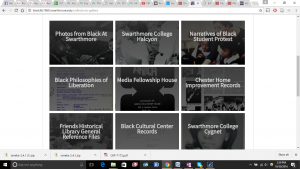
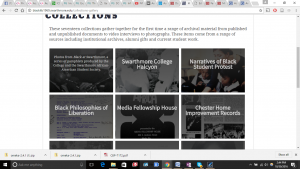
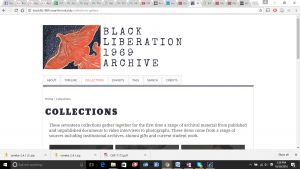
Here’s how this format is used on Swarthmore’s Black Liberation website:
Screenshot (3) Screenshot (4) Screenshot (5) Screenshot (6)

Instead of the squares saying, “photos from Black at Swarthmore,” “Swarthmore College Halycon,” etc., the squares would have a quote in them.  Like I said, moving the pointer over the square would reveal a small description of the topic that the quote is meant to interrogate.  And when the square is clicked on, it would take viewers to an integrated narrative; that is, rather than the squares taking readers to transcriptions of individual interviews, the actual page would be an integration of several interviews, as well as scholarly essays, newspaper articles, and pictures/data from Geneseo’s college archives.  In this way, we would have a multi-layered narrative that demonstrates how all of the smaller components of our research project come together.

For instance, something that I feel is very important to our investigation into the humanities sequence at Geneseo is the desire from both students and faculty to make the humanities sequence a global investigation, instead of just an examination of Western beliefs.  I’ve tended to sympathize with these desires, as does Ken Asher, the professor we interviewed this week–but he brought up a really interesting point regarding this issue:  academic responsibility.  When we were discussing the possibility of making the humanities a non-western course, he responded that while he sympathizes with this effort, the adherence to Western philoshopy isn’t out of a “conservative Western point of view,” but the necessity of being knowledgeable and “academically responsible” about teaching global philosophies in order to respect the subject matter.  Professor Asher added that Geneseo just doesn’t have the faculty to achieve this goal:  “we don’t have anybody in Chinsese philosophy here.  We did at one time, but we don’t anymore.”  If Chinese philosophy was added to the humanities sequence, Asher asked, “who would be knowledgeable enough to staff 26 sections of this?”  His ultimate point was that Geneseo doesn’t hire professors who teach these global philosophies–so while it would be great to have a global humanities, we just don’t have the staff to do so with academic integrity.  We had a lot of great discussion on this matter, and I think that once we have several more interviews, and some formal research into the matter, this could yield a really interesting page on our website–especially regarding how the course is staffed and what other courses the college teaches.  Possible organizing quotes from the interview could be “it really isn’t out of a conservative Western point of view,” “you have to be academically responsible,” or “who would be knowledgeable enough to staff 26 sections of this?”  And the short description could read:  “An interrogation of the tension between teaching Western Humanities and the desire to teach Global humanities.”  Or, it could be much more argument based; the description could read, “how Geneseo’s hiring practices unintentionally reinforce the Western Canon.”

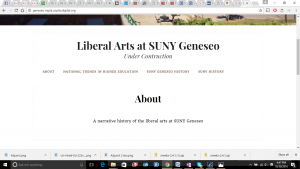
Emily and I need to discuss how we see the website functioning, but I think our website currently lends itself really well to the sort of organization I’m discussing.  Here’s how our website looks now:
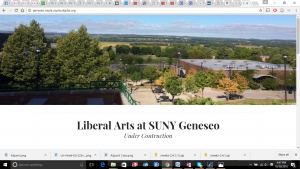
Screenshot (11)Screenshot (12)

If we make the changes I’m discussing, I think it would be cool if we had the boxes with quotes at the very beginning of the website (the home page); it would replace the “about” page that is currently up.  Accordingly, the viewer would immediately be immersed in our project.  We could keep the tabs along the top of the page to show the viewers that there’s more than one dimension to the project.  And while this opening page would probably be the most immersive and integrated, the tabs along the top would probably consist of more isolated aspects of our research, like an interview archive and bibliography–but also the isolated elements that will contribute more or less to the integrated homepage:  national trends, SUNY mandates, and our archival research.  Consequently, the narrative–the story–of our project is brought to the fore without compromising the transparency of digital humanities research .

So why am I spending so much time explaining what I want to do with the page instead of actually making the changes?  Making this sort of layered narrative is difficult.  I’ve downloaded a project building software called “Omeka”–the Swarthmore Black Liberation project used this on their website–as well as a wordpress plugin in order to actually integrate this organizational structure with the website.  But Omeka isn’t the easiest to use, and its going to take me some time to get used to it.  I’m hoping that by next weekend I’ll at least have a template of these ideas on the website.  I probably wont have the actual quotes yet, but if I can create a functional place holder, I would be really happy, and I think that would put us in a good position to integrate what research we’ve already done.

Research Reflection: Looking Ahead

I’m going to be honest. In weeks 7 and 8, I really was falling behind. I was feeling so overwhelmed that I became complacent. It was kind of a lull.

I’m turning it around! I became very inspired when meeting with Larry Benaquist on Tuesday with Mark. I felt more confident in myself and my work now that I feel like I have more of a direction with what I’m doing.

On Tuesday, I’m meeting with Norma Walker. I’m looking forward to that interview, because stories like hers are exactly what I’m searching for in this project. Mark and I are also trying to get in contact with Doris Eder, another alumna.

This project is trying me as a student. I’m being pushed to trust my instincts more, and to become more accountable for what I’m doing. It’s hard, but the work I’m doing is so important to me and I’m looking forward to completing the project and being able to share the finished product.

The Real Work

The checklists below are designed to help you complete the work on your course blog during the two weeks before we break for Thanksgiving. Your course blog is a process portfolio that Cole and Mark will use to help determine your final grade in the course. We highly recommend that you compete this work using the checklists below so that you will be able to direct all of your attention to your project sites in the final four weeks we will be working together.

Week 9 October 31-November 4

Tuesday November 1: Cole and Mark are available to meet with project teams by appointment

Thursday November 3: Project Charrette

Checklist for Week 9:

1. Course Blog

  • Complete your 8th Research Reflection by Sunday evening
  • Add the Category “Research Reflections” to each of your blog posts
  • Add any tags to each of the posts in your collection of Research Reflections
  • Convert all URLs in your posts to links
  • Consider the title of each of your Research Reflections. Make concise but make descriptive
  • Add relevant links (Your College, your Library Archive, a story on the College web site, COPLAC, etc.) to your Links or Blogroll

Add Categories to your Links Widget. (For example, you might have links under “Geneseo” and you might have links under “External links”

2. Project Site

  • Add a License to your Project Site using Creative Commons Attribution International License. To recall the reasons and protocols for doing this, see the Weekly Update Create Manage License on the NAPLA blog
  • Consider adding social media icons to your site. This will require you to go to your WP Dashboard > Plugins > Add New > Search Plugins
  • Make a list of design features of your site. We have encouraged you to look at “exemplar” sites that allow the designer to organize and present information. Then browse or search WP themes
  • Use the list of design features of your site to search WP plugins Then browse options for what you are looking for. For example, you might be looking for an image scroll, slider, or carousel; an image or a video gallery; a video embed and thumbnail generator

For planning purposes, please check in on the Schedule page. This page has been updated. Please check your calendars and let Cole and Mark know if you have any conflicts so that we may adjust the schedule accordingly.

Research Reflection: Gathering Interviews and Planning a Layout

So far within my individual research for our COPLAC project, I have organized two interviews for next week. One is with Professor Darin Waters, who is in the history department and has a concentration in African American history in the South. He is very familiar with Asheville’s cultural history, and has had family in the area for several generations. His grandfather, Isaiah Rice, had recently had a photography exhibit through our Special Collections archive that essentially documented the African American experience in Asheville in the 1950s. Waters also has a son who started attending UNC Asheville this semester; he has a unique relationship with UNC Asheville as both a faculty member and a parent of a student. He works as an assistant to the Chancellor as well, and has a greater understanding of the inner workings within our university than some.

We also plan on interviewing Gene Hyde, the Special Collections archivist. As our university archivist, in an archive that heavily contains historically valuable documents, photographs, books, and other materials relating to our university’s history, he would be a beneficial perspective to have as part of our documentation of our university.

I’m beginning to experiment with TimelineJS, a program we will be using in our website. I’m less familiar with it than my partner Casey, but have had some experience using it in a history course I’m currently in. It is a useful tool for creating a concise timeline, with access to implementing audio, photographs, and video components in it. We are also working on a visually appealing and clear design for our website. Implementing TimelineJS might be difficult and will definitely be taken into consideration while designing our website’s layout.

The Relationship Between Liberal Arts and Digital Humanities

Liberal arts and digital humanities both place an emphasis on the disciplines of humanities as a field. They have somewhat similar objectives in regard to the content that they focus on, but have different methods; digital humanities looks at how to apply these disciplines to the digital sphere, including digitizing historical documents and other texts. This also includes digitizing and publishing of oral interviews, relating to oral history, a significant part of our COPLAC project.

Liberal arts and digital humanities overlap significantly, sharing the same objectives and overall concepts, while digital humanities translates these concepts through digital tools to places like the Internet. The connections between these two support my research process for the COPLAC digital project because the methods make oral history much more accessible and easy to document. The ability to record and digitize interviews has significantly benefitted the field of oral history, and add a level of understand to the individual experiences and perspectives throughout history.

History, as a core element of humanities, oral history in particular, is most supported by the digitizing of the concepts of humanities by relating larger events to individual experiences. In a sense, oral history would not be what it is if not for the ability to digitize and publish sound recordings of interviews. The listener not only is able to understand the unique perspective and recollection of a historical event, they are also able to better observe and evaluate the event itself.

css.php