Contemplating on the Public Process and Product

As I’ve never encountered the digital humanities outside of a liberal arts setting, it is difficult for me to fully separate the two fields. I consider digital humanities to be an extension of the liberal arts, providing new platforms for the research and accessibility to a wider audience.

The audience is a particularly important aspect of digital humanities projects, including ours. Sheila Brennan, in her essay “Public, First,” emphasizes the need for identifying a specific audience: “Doing any type of public digital humanities work requires an intentional decision from the beginning of the project that identifies, invites in, and addresses audience needs in the design, as well as the approach and content” (384-85). I think that knowing the audience the site is being built for will make my research and the site itself more pointed and purposeful.

Digital archives such as ours also need to be usable for other researchers, as discussed by Rachel Buurma and Anna Levine. They stress the importance of paying particular attention to details including categorization and the distinctions of data and meta-data, and suggest using what they coin the “liberal arts research imagination” as guidance through the process (276). This specific aspect of the project is among the more daunting to me, partly because of my lack of technological prowess and partly because it seems kind of boring, so I will definitely try Buurma and Levine’s described methods when I reach this stage of the process.

Later in their essay, Buurma and Levine give an overview of a digital archive built by students and faculty of Swarthmore College, Black Liberation 1969. They note that the site is created to allow for multiple interpretations and readings, and their description of the archive as “open-ended” struck me as particularly significant (276). While I value the importance of leaving room for interpretation, the phrase reminded me more that Geneseo will (hopefully) continue as an institution after our project is complete. The future of the college is itself open-ended, and its curriculum and identity as a public liberal arts college will likely continue to evolve, and we would be remiss to not consider this throughout the research process. While this was not Buurma and Levine’s intended meaning, I feel that it will be helpful moving forward.

Works Cited

Buurma, Rachel Sagner and Anna Tione Levine. “The Sympathetic Research Imagination: Digital Humanities and the Liberal Arts.” 2016.

Brennan, Sheila A. “Public, First.” 2016.

How the Public Becomes Personal and Vice Versa

Reading about the necessity for liberal arts and history in a public context echoes much of what I’ve already said and heard during the development of this project.

In Sheila Brennan’s essay, “Public, First,” she discusses the importance of accessibility in the digital humanities. With this project, I’m taking on the role of a facilitator of the liberal arts, and my responsibility goes beyond just putting words on a screen. Online doesn’t always equal public, so making sure people know about what I’m doing and are able to easily access the project.

Accessibility isn’t the only feature of a strong digital humanities/public history exhibit. It’s also about welcoming a specific audience who otherwise may have not stumbled upon the site.

I occasionally have a challenge with realizing that Keene State isn’t an integral part of everyone’s family legacy. Because of that, I have a special responsibility to show people, especially those who participate in our school’s community and culture, what I know and what I am learning.

Further on in the collection of works on the structure of the digital humanities, Rachel Buurma and Anna Levine talk about the importance of research strategies and skills in “The Sympathetic Research Imagination: Digital Humanities and the Liberal Arts.”

Much of digital humanities is being the middle point of research between the primary sources and what becomes secondary sources. In this project, I am searching and sorting information to create a gathering of personal narratives. This decision of which pieces of history I include are small decisions, but to each person who accesses this site, they could be monumental.

It’s unfortunate that I only have two and a half more months to create this archive, but I believe that the process of researching and gathering is as important as the finished project.

Asheville’s Higher Education in Relation to the U.S.

The changing needs of Asheville’s community greatly affected UNCA, particularly in the way it moved locations and merged with other institutions of higher education to become what it is presently.

In the early 20th century, the United States saw a dramatic increase in K-12 education, both increasing the need for teaching college/high education institutions as well as for institutions for the increasing interest by students to pursue education past K-12. In order to handle this dramatic growth in K-12 education, states set up their own networks of teachers’ colleges. This began with Massachusetts in the 1830s. After 1950, these teachers’ colleges became state colleges and then state universities with a broader curriculum. This is indicated in UNCA’s own historical timeline, as increased enrollment made the college to move to Seely’s Castle in 1949.

UNCA, which was Asheville-Biltmore College at the time, became the first two-year college in North Carolina to receive state funds in 1957. It was the originator of North Carolina’s community college system. Junior colleges, which had grown in popularity by the 1950s and 1960s, were renamed “community colleges”.

Many state universities experienced an explosive growth from small institutions of fewer than 1,000 students to large campuses with 40,000 or more students, as well as a network of regional campuses around the state. In turn, these regional campuses broke away and became their own separate universities. UNC Asheville did not grow to such a dramatic population increase; the student population did not exceed 1,000 until 1970. However, UNC Asheville has many factors that affect its population growth, including the desire to remain a smaller liberal arts school that is still emphasized today.

UNC Asheville, while still named Asheville-Biltmore College, also admitted its first African American student in 1961, when the desegregation of institutions of higher education began to slowly break the barrier in racial exclusion at the collegiate level.

Many of the actions that took place in UNC Asheville’s history aligned with the general history and development of high education in the United States in the 20th century. Asheville-Biltmore College/UNCA accurately exemplifies the changes seen all throughout institutions in the United States in a chronological manner.


Citations:


Jesse P. Bogue, ed. American Junior Colleges (American council on education, 1948)

Lois Staton (July 1980). “Overlook” (PDF). National Register of Historic Places – Nomination and Inventory. North Carolina State Historic Preservation Office.

“Timeline.” About. University of North Carolina at Asheville, n.d. Web. 10 Sept. 2016.


For Me and For Someone Else: Performing the Research Process

Research Reflection Prompt #3

Due: Sunday, 2 October

Introduction and Context             Last week we talked about the direction of post-secondary education and “training” under the GI Bill and how that may, or may not, have been reflected on your campus – in its curriculum, in its mission, in its physical spaces, in its financing education, in the demographics of its student body, etc.

This week, we’ll be meeting with you as teams to discuss your intellectual work so far and your ideas and design for a Digital Humanities project.

In addition, this week’s reading looks at where two authors see an important intersection between the liberal arts and Digital Humanities – in making the research process visible and in trying to think about ourselves and others, to anticipate what we and others need as we structure a narrative, to be “sympathetic” as we research.

As you read the essay 1) gather insights and take notes for your third piece of writing, which will be posted on your blog by Sunday, 2 October;  2) feel free to discuss the insights or questions you have about the “sympathetic research imagination” with your team mate, with your friends and mentors, with your research support network, and with us; and 3) consider how the reading might shape the kinds of questions you use in the interviews you’ll be conducting later this semester – what does liberal arts mean to the people you talk with?  What do they think about being part of a process of collecting stories and curating a narrative about your college?

For your third blog post, please discuss:

1) the relationship between what you understand the liberal arts and digital humanities to be (viz., overlaps? irreconcilables? same objectives, different methods?  different objectives, same methods, etc.), and

2) how those relationships between the liberals arts and Digital Humanities connect, challenge, or support the research process you’re doing for this COPLAC digital project – a developing, evolving project done in public.

 Reading List 

 Everyone should read “The Sympathetic Research Imagination” (2016).

The Digital Humanities project discussed in the article is Black Liberation 1969.

Another short essay related to this topic of being intentionally “slow” and intentionally “public” is Sheila A. Brennan’s “Public, First” (2016).

Toward a Privatized Public University

“The United States Country Report: Trends in Higher Education from Massification to Post-Massification,” suggests that higher education followed a linear path through three eras:  massification, maturation, and post-massification (Gumport 1-3).  Massification refers to the explosive development of higher education following the institutionalization of the GI Bill and the new population seeking college degrees.  Maturation identifies the era following massification, when institutional expansion slowed; this era was characterized by a diversification of the student body, a distinction between the student and the worker, and changes in college tuition.  Post-massification, then, indicates an era in which institutions felt the pressures of a changing market and a population that had become disenchanted with the perceived “public good” of higher education. 

The story of Geneseo, according to “The Transformation of SUNY Geneseo,” is much more convoluted—and even seems to present an evolution contrary to the trends suggested by The United States Country Report.  In the 40s, 50s, and 60s, Geneseo certainly saw the massification caused by the GI Bill, however, in the period of time from the late 60s to early 90s, Geneseo’s era of maturation seemed to coincide with its era of post-massification; that is, at the same time Geneseo’s student-body was diversifying, the administrators at Geneseo seemed to recognize and capitalize on the upcoming shift in market values and changing values of the general population that brought about the demands of the post-massification era.

In the 70s and 80s—and even earlier—Geneseo embodied the trends presented by the country report.  Geneseo’s “new student majority” consisted of students at or above the age of 22; the student body was increasingly comprised of part time student who held full- or part-time jobs; women were the predominant gender at the school, and racial minorities contributed to a greater percentage of students (Mahood 214-220).  Yet, Geneseo was at once ahead of and behind its time:  while most Universities in the era of maturation saw increased faculty and staff, Geneseo was faced with the possibility of enacting six levels of faculty cuts (SUNY at Sixty, 65).  Additionally, proposed construction projects, including the building of new dorms and classrooms, were denied and/or suspended.

The administrators at Geneseo had to make a decision:  decrease selectivity and thereby increase enrollment in order to receive greater state and federal aid, or hold true to their values.  They did a little of both.  In 1977, Geneseo accepted 88% of students—its highest acceptance rate in the institutions history—in order to stave off faculty cuts (SUNY at Sixty, 70).  Geneseo’s next actions anticipated trends in higher education, fiscal conservatism, and public opinion that most higher-ed institutions would not react to for at least ten years.

By increasing enrollment, administrators sought to increase the potential audience for the solicitation of their changing institution.  First, Geneseo increased its professional/vocational programs—administrators created the BS in accounting and expanded the business and economics programs, started programs in the field of urban studies, and expanded fields such as biochemistry, physics, and computer science (SUNY at Sixty, 67).  According to the country report, the trend of increased vocational programs in higher-ed didn’t take off until the late 80s when the consumerist population—who increasingly saw higher-ed as an irresponsible use of resources—demanded that higher-ed institutions provide educations with more practical implications (Gumport 30).  At the same time, professors created Geneseo’s hallmark courses, Humanities I & II; these courses ground Geneseo in its status as a liberal arts institution by asking students to explore the philosophy, history, and literature of prevailing Western ideologies (SUNY at Sixty, 69).  After just one year at 88% acceptance, Geneseo returned to its rigorous standard and accepted fewer than 50% of applicants.

After achieving a good balance between vocational courses and liberal arts studies, administrators began a scourge of departments that they saw unsuccessful in anticipation of the fiscal conservatism that would limit Geneseo’s funding.  This began with the removal of drama, dance, and physical education departments, although students could still enroll in individual courses in these areas of study.  At this time, the school also saw cuts to art and music.  Most shockingly, administrators dissolved the School of Library and Information Science due to its declining enrollment rates; in dissolving this most traditional department, scholars noted Geneseo’s move toward privatization:  although a public school, Geneseo became more concerned with the values of private schools—selective admissions, name value, and adoption of market ideologies—than with that of public schools, namely providing an accessible education to all.

Yet, these were not the only changes at Geneseo.  At a time when most universities were increasing faculty and staff, Geneseo fired 104 faculty members (SUNY at Sixty, 73).  However, the institution saw this as an opportunity to develop a new teaching staff with different expectations:  taking advantage of the fact that the federal government was investing more money in research institutions than ever before, Geneseo made it clear that professors would both teach, and perform research (Gumport 25, SUNY at Sixty, 75).  Accordingly, administrators outfitted Geneseo with both a faculty and a curriculum that would provide the most “bang” for a student’s “buck.”  In a time when most universities were expanding, Geneseo doubled down on its qualities that administrators thought would favor conditions of the changing market.   Whether by chance, or keen insight, Geneseo’s recognition of changing values allowed it evolve into the “public Ivy” that it is considered to be today.


Citations:

Gumport, Patricia, Maria Iannozzi, Susan Shaman, and Robert Zemsky. The United States Country Report: Trends in Higher Education from Massification to Post-Massification. Rep. N.p.: n.p., 1997. Print.

Bright, Frederick, and Wayne Mahood. SUNY Geneseo: 125 Years of Excellence. Geneseo: Clarion Publications, 1996. Print.

Mahood, Wayne. “”A Touch of New England in Western New York:” The Transformation of SUNY Geneseo.” SUNY at Sixty: The Promise of the State University of New York. Albany: State U of New York, 2010. 63-76. Print.



Higher Education In A Changing Western North Carolina

The development of UNCA has always been heavily linked to the community and wider nation, even before it was a part of the UNC system.  The adoption of the GI Bill, along with the rapid expansion of a true American middle class, can be clearly documented in my previous history on UNCA, which I’ll elaborate upon here.  The late forties saw a large amount of new legislation reaching Asheville, with lawmakers allocating funds and laying the groundwork for a state-funded school in Buncombe county due to an increased demand for higher education for many citizens.  The fifties and beyond saw an incredible increase in enrollment for the campus, along with it becoming the first two-year college to receive state funds.  Because of the constantly increasing and diverse student body, it was also the originator of the modern day community college system in North Carolina  It was around this time that the offer to join the syndicate of North Carolina universities was made to UNCA.  The campus relocated for a final time after all of these changed were made.  With state funds and a switch to the baccalaureate system, the university remained uncharacteristically stable.  UNCA hasn’t moved or had any major setbacks or structural changes since the early seventies when it was finally adapting and flourishing under a post-GI Bill education system.  Seemingly crucial to the success of the university was its continuing tradition of public education, combatting the wealth of private schools in Western North Carolina at the time.  UNCA seized a prime opportunity to capitalize on a burdening education-seeking middle class, by being a state funded public school that was the only member of the UNC syndicate in the area. While it may have taken some time for UNCA to get it’s footing after major educational changes nationally, it managed to persevere and thrive.  The massification of higher education sweeping across America had a clear, positive effect on the city of Asheville and the university as a whole.

Sources:

Gumport, Patricia J., et al. “The United States Country Report: Trends in Higher Education from Massification to Post- Massification.” Academic Reforms in the World: Situation and Perspective in the Massification Stage of Higher Education,1997.

“UNCA Timeline.” UNCA.edu. Accessed September 24, 2016.

The GI Bill, Higher Education, and Race in a Post-War Enviroment

As an avid student of social justice and political science, I’m fascinated by the role of a male veteran in American society. I’ve been having a surprisingly difficult time finding scholarly sources on my own institution’s role in the recuperation of young World War II veterans. However, the amount of primary sources available through the United States government provides me with a first-hand account at how education policy intervened when a generation of men returned from the battlefields.

While college enrollment increased in the late 1930s, education for all young men was interrupted at the start of World War II. Boys in secondary school, too young to be drafted, dropped out to work in industries which supported the American forces (Stanley 677). Young men in postsecondary institutions had to leave their studies when they were drafted. Because one could not volunteer for the armed forces until later on in the century, young men were unaware of when they would be sent off to fight (Stanley 676).

The amount of men returning to build the post-war economy was so vast, politicians needed to find a way to readjust these new, young veterans in to society. The GI Bill (formally known as Servicemen’s Readjustment Act) passed in 1944, which dramatically changed the accessibility and prevalence of post-secondary education. About seventy percent of men who turned 21 between 1940 and 1955 essentially had a free four-year degree waiting for them at whichever institution they chose–as long as they were Caucasian (Stanley 671).

The federally funded GI Bill Act makes it clear that it is separating itself from state legislature. The state legislature in the Jim Crow states, as well as the Southern Congressional leaders in D.C., worked the ensure that the GI Bill only helped White students (Kotz). Because of this, returning Black veterans were denied loans, mortgages, certain career paths, and college acceptances (Kotz).

The prevalence of African-American veterans looking to take advantage of their right to higher education overfilled the only Black colleges. Black veterans were being turned away from their own schools because of overcrowding (Perea 595).  While the White Americans under the GI Bill were able to build a new, prospering middle class with their post-secondary educations, the African-Americans were blatantly excluded both in government policy and personal discrimination.

Although Keene State is, was, and most likely will be, a predominantly Caucasian institution, it is still vital for race to be included with my story and research on higher education in this country.

Works Cited

Kotz, Nick. Rev. of “When Affirmative Action Was White” New York Times 28 Aug. 2005: n. pag. Web. 25 Sept. 2016.

Perea, Juan F. “Doctrines of Delusion.” University of Pittsburgh Law Review 75 (2014): n. pag. Google Scholar. Web. 25 Sept. 2016.

Stanley, M. “College Education and the Midcentury GI Bills.” The Quarterly Journal of Economics 118.2 (2003): 671-708. Web. 25 Sept. 2016.

The G.I. Bill’s Tiers of Effects

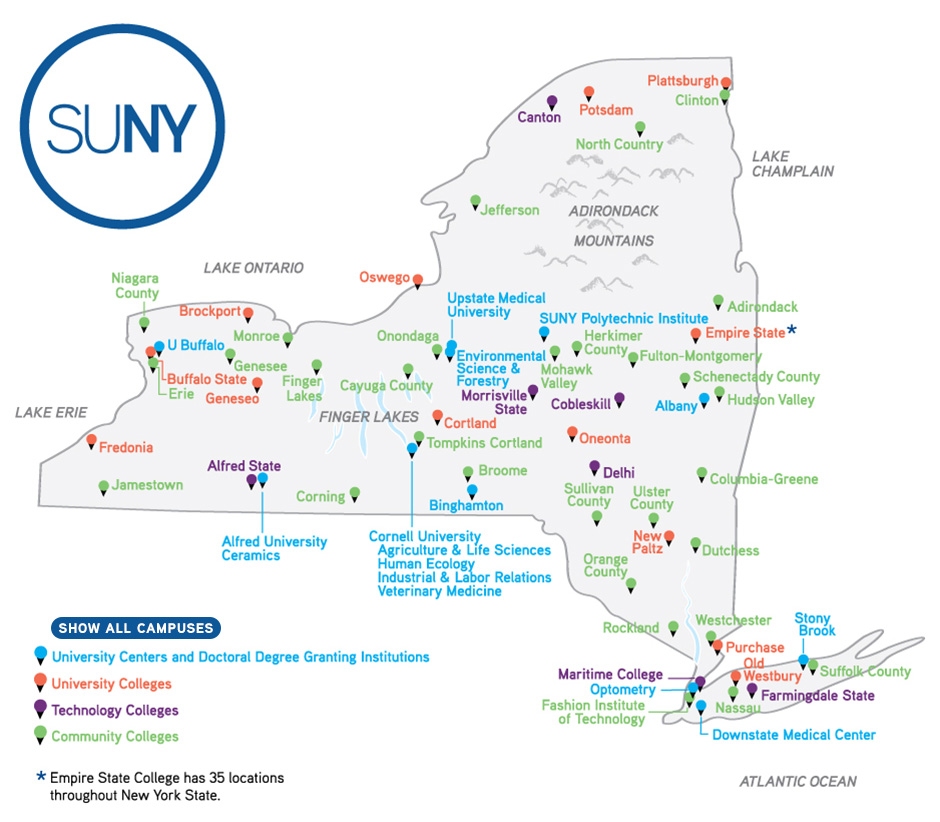
Since the start of the course, I’ve been wondering how big a role the State University of New York (SUNY) should play in the final project. While it is a large and complex system, Geneseo maintains a distinct identity while simultaneously being a part of that system. With this in mind, I’ve decided to look at the effects of the Servicemen’s Readjustment Act of 1944 (also known as the G.I. Bill) at the state (SUNY) and local (Geneseo) levels.

SUNY was established in 1948, only two years after a commission on the matter was established, in direct

SUNY's current campuses

SUNY’s current campuses

response to increased access to higher education made possible by the G.I. Bill. Governor Thomas E. Dewey noted that private institutions in New York would not be able to contain the expected surge of veterans, making greater organization at the public level necessary (Mahood 146). However, despite (and perhaps because of) the rapid speed at which SUNY was established, there was a great deal of confusion and discord surrounding the institution during its founding and the first few years of its existence (Mahood 147).

In Geneseo, the impact of the G.I. Bill were not immediate, with only gradual increases in enrollment from the 1946-47 year until the 1957-58 year, which saw an increase of over two-hundred and fifty students from the previous year; however, the 1953-54 year saw a concerning drop in enrollment from the previous year (Mahood 311). The eventually significant growth of the student body meant that the long-awaited dormitories, construction of which had been put off during World War II, were all the more necessary (Mahood 148). Despite ongoing battles with SUNY and the state legislature for funding, thirteen dormitories were built on campus between 1950 and 1970, as well as several academic and administrative buildings (Mahood 316).

The murkiest of the effects of the G.I. Bill was the SUNY’s mandated conversion of Geneseo, as well as the other public teachers colleges, into liberal arts colleges. Mahood describes the initial designation as a “multipurpose college,” and I feel that this better reflects the intent of the G.I. Bill, which I read as having a greater focus on educating veterans for a specific place in the workforce (Mahood 167). “Multipurpose” seems to be a less constricting description than “liberal arts,” which brings to mind a much more defined purpose and curriculum. Additionally, there did not appear to be any initial deemphasis of Geneseo’s education programs, which fit in closely with my reading of the G.I. Bill’s intentions.

Patricia Gumport’s study in the trends of higher education report that the number of Baccalaureate-Granting Institutions (of which I consider Geneseo to be at least at the time of Gumport’s study) generally decreased throughout much the latter half of the twentieth century, making Geneseo’s increasing success during the same time period all the more fascinating (14). I hope to further explore this surprising success, as well as Geneseo’s occasionally contentious relationship with SUNY (mostly due to funding issues) as I continue my research with the general trends of higher education in mind.

Works Cited

Gumport, Patricia J., et al. “The United States Country Report: Trends in Higher Education from Massification to Post- Massification.” Academic Reforms in the World: Situation and Perspective in the Massification Stage of Higher Education, 1997.

Mahood, Wayne with Frederick Bright, Judith Bushnell, Paul Hepler, and James McNally. SUNY Geneseo: From Normal School to Public Ivy, 1871-2007. The Donning Company Publishers, 2008.

Create Manage License

One of the objectives we have during the first half of the course is for you to create and manage content using Word Press.

imgres

Below is a checklist to get everyone caught up managing content on your course blog. The checklist is also designed to develop your skills (such as adding images and links) and establish habits, or protocols, (such as including categories and tags when you publish a post. Finally, we are introducing below a conversation we will have together about rights and responsibilities for creating and sharing content in the digital commons.

Here is your checklist:

Manage Your Blog

  • Add an Image to your About page (See example on Julia’s About page for an example). Consider Justifying image left or right and wrapping text using image editor. If fo rany reason you do not want to use an image of yourself, please choose an appropriate image that you would like your readers to associate with your blog
  • Add or Modify the Blog Header You don’t have to have a header. And what you can do with a header is in some cases determined by the functional capacity of the theme you have chosen. Still, headers are attractive and can serve to reinforce or echo the blog theme. Julia’s Liberal Art in the Land of the Sky is a good example. We might consider whether Emily’s fabulous image on Geneseo’s Educational Evolution is too large. On most screens, the reader will need to scroll before getting any information. John’s Liberal Arts in the Beautiful Valley is also large. This image is a bit grainy as well, and it may be that the resolution of the image may not support the size
  • Add a Links or Blogroll Widget (if you do not already have one). Delete any default WP links that do not seem relevant or necessary. Add your College home page (Title of the link should be the name of the College!). Add COPLAC. Add any other relevant links. Make a note to add relevant links as you continue in the course

License your Content

  • Add a License to your Blog As authors creating and publishing content on the web, we need talk about copyright and the commons, digital communities, collaboration and sharing. First, go to the bottow of the NAPLA course page and have a look at the Creative Commons Attribution 4.0 International License icon. Next, visit Creative Commons and watch the three-minute Creative Commons Remix on Vimeo. Read About Our Licenses and What They Do. You will learn how the licenses for your work are designed to address legal, human, and software considerations. Then, choose a license. The NAPLA course blog uses the least restrictive license. The 4.0 License lets others distribute, remix, tweak, and build upon our work, even commercially, as long as users credit us for the original creation. You retain copyright while allowing others to copy, distribute, and make non-commercial uses of your work. Once you have chosen a license (we recommend the one above), add a Text Widget to your Blog. Put the text widget at the bottom of the widget sidebar. Paste into the Text Widget Window the following code:

<a rel=”license” href=”http://creativecommons.org/licenses/by/4.0/”><img alt=”Creative Commons License” style=”border-width:0;” src=”https://i.creativecommons.org/l/by/4.0/88×31.png” /></a><br />This work is licensed under a <a rel=”license” href=”http://creativecommons.org/licenses/by/4.0/”>Creative Commons Attribution 4.0 International License</a>.

Save and close the widget window. Voila! Welcome to the digital commons!

Revisit and Revise Your First Post

  • Add a Category Open edit for your first blog post and add the category “Research Reflections.” Make a note to add this category to all of your subsequent weekly writing posts
  • Add Another Category Add your first and last name as a Category to your post. This way the NAPLA course blog (where your posts also appear) will list your name under categories. Then you (or another reader like you mom or your uncle) will be able to click on that category and read a digest of your posts on the course blog. Make a note to add this category to all of your subsequent weekly writing posts
  • Add Tags Go through your first blog post and identify key words and concepts, people, place names. Add three or more Tags to the post
  • Add one or more Links Highlight text > add a URL > save (or command + K on a Mac). Casey’s Blog Post, for example, at the bottom under “Sources,” can embed the URL on the list by using the link tool. And Julia’s Blog Post can take existing text and add a link to COPLAC and a link to the UNCA Fact Book.

Complete the steps below by the end of the week. If you have any questions please let us know. We will troubleshoot and field questions during class or by email. Have fun!

wordpress-tag-cloud-2

Reading & Writing

Research Reflection Prompt #2
Due: Sunday September 25

Introduction and Context This week we will will be reading selected materials on the history of higher education in the United States. You will then write a blog post on the relationship between higher education in the United States in relationship to the local history of your institution.

gi-bill_thumbThere are many book-length histories of American post-secondary education in your campus libraries. And we invite you to read in this material. However, for the purposes of this course, and the intellectual work you are doing this week, we have compiled selected materials that will introduce you to the governmental policies, social trends, and cultural forces that helped to determine the direction of post-secondary education during the past century.
As you read 1) prepare to bring your observations to our class discussion of post-secondary education this Thursday, 2) gather insights and taking notes for your second piece of writing that will be posted on your blog by Sunday and 3) use what you are reading to begin thinking about the kinds of questions might be the most useful in the interviews you will be conducting later this semester.

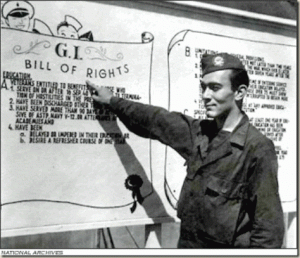
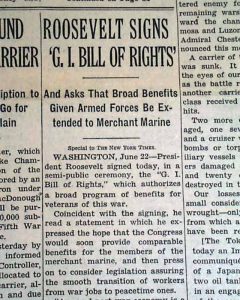
Reading List Everyone should read the Servicemen’s Readjustment Act of 1944

image035The relevant section for us is Title II Chapter IV Education of Veterans, 6-14. The pamphlet The Gi Bill of Rights and How-it Works provides another version written for military personnel that includes a complete text of the Bill and “An Explanation of its Provisions” and “Questions and Answers.”


Here is a short list of other readings that we believe will be helpful for all of you to consider as well:

College Education and the Midcentury GI Bills
, by Marcus Stanley, The Quarterly Journal of Economics, Vol. 118, No. 2 May, 2003: 671-708

Review of When Affirmative Action Was White: An Untold History of Racial Inequality in Twentieth-Century America, by Ira Katznelson. New York Times August 28 2005

Brown vs. Board of Education

Federal Elementary and Secondary Education Act of 1965

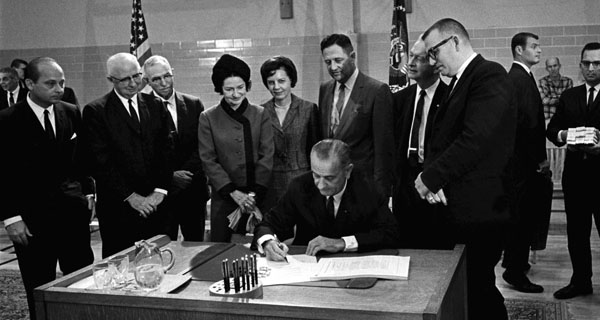
President Lyndon Johnson signing the Federal Elementary and Secondary Education Act of 1965

Trends in Higher Education from Massification to Post-Massification, by Patricia J. Gumport
, et al. Academic Reforms in the World: Situation and Perspective in the Massification Stage of Higher Education. Reports of the 1997 Six Nation Higher Education Project Seminar. Hiroshima, Japan February 6-7 1997

Distinctively American: The Liberal Arts College, by Eugene M. Lang, Daedalus. 128.1 (Winter 1999): 133-50

The Higher Education Resource Hub Page


css.php