This Week in Research: Women’s Work to Women’s Studies

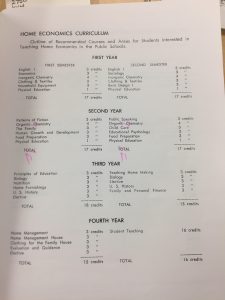
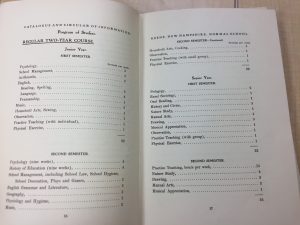
When I went to the archives on Tuesday, I found a course catalogue from 1912 with the overview of credits needed for a young woman to get a teaching degree at Keene Normal School:

1912
Requirements to Become a Teacher: 1912

Among the course requirements were to be expected: pedagogy (the methods of teaching), school law, and sociology. However, this overview also included courses under the heading of “Household Arts.” These courses covered cooking and sewing. Most of the women attending this institution were straight out of high school, likely unmarried, so they needed an education in how to manage a household after they married and ended their teaching career.


Fifty years later, when Keene became a Teacher’s College, women were still attending the institution to become teachers (even though men were now attending as well). In the 1964 course catalogue, there were more degrees with specifications in subject matter. One of these degrees was in Home Economics.

1964
Bachelor’s in Home Economics: 1964

This degree program included student teaching, sociology, and principles of education. It also included classes towards the required skills needed of a female “Baby Boomer,” such as interior decorating and the operation of household machinery. My maternal grandmother graduated with a degree in Home Economics from Keene State College in 1968–and she had my mother a month after her Commencement.

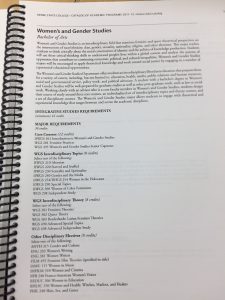
One hundred years after the first course catalogue I found, Keene State College offered a Bachelor’s of Arts in Women and Gender Studies. This liberal arts degree is a stark transition from the Home Economics degree.

The BA in Women and Gender Studies in 2011: one of its first years as a four-year degree program.

According to the Keene State website, Women and Gender Studies focuses on “the social origins and related politics of identity.” A student at Keene State is also eligible to add this major to his or her education degree.

—

These three degrees, each offered fifty years apart, show both transitions in education and a woman’s role in society. I’m very interested in studying the intersections of gender and education and how it relates to this college. This project is going to focus on stories which made Keene State what it is today, and women play an integral role in that.

Sympathy/Antipathy in Geneseo’s Humanities

Our class discussion today about the “sympathetic researchers” in Buurma’s article made me think about the Humanities sequence at Geneseo, considered to be (and advertised as) the cornerstone of our liberal arts curriculum. The sequence consists of two courses that examine the development of western civilization primarily through “Great Books,” and are primarily taught by English, history, and philosophy professors (more in-depth description here). Most relevant to our discussion is the fact that all students are required to take these classes as a graduation requirement, and students of all majors and backgrounds end up in the same classes. This mixture of students often produces the variety of insights that Mark mentioned when discussing interdisciplinary classes. I’m currently taking Humanities II, and the range of opinions in what is still mostly an English class (I will admit I’ve purposefully taken both courses with English professors) is refreshing compared to my major classes, where everyone is trained to look at the texts in the same ways (not that this leads to everyone having the exact same thoughts).

In terms of my site, I’m still not exactly sure how Humanities will figure in. I discovered through some (very brief) googling that at least among the SUNY schools, our program is quite unique; several schools have humanities general education requirements, but a number of different courses that fulfill them (including Albany, Binghamton, and Purchase).

Furthermore, the history of the program at Geneseo is more than a little contentious. As I learned when researching for my first blog post about the college’s history, the program took several years to fully establish after its conception. From what I can tell, the curriculum has not drastically changed, but I hope to find further information on this in the archives (which I plan to visit within the next couple weeks). On the first of class this semester, my Humanities professor told the class that since its establishment, various forces have been trying to remove the sequence from the graduation requirements. While I currently don’t have much to back this up, I think it’s entirely believable, because most current students dread taking the courses (I will attribute this partially to traumatic registration experiences).

In my interviews with current students and alumni who took the courses, I definitely intend to address this aversion to Humanities; the requirement certainly isn’t kept a secret during the admissions process, so why choose a school like Geneseo if you know you will hate these classes? I also want to discuss this with the professors who teach the courses. While I’ve gone back and forth on the possibility of interviewing a greater ratio of English professors than those in other departments, I currently feel that interviews with a number of different professors who teach/have taught these courses may be more beneficial to the project as a whole than a more equal spread across the disciplines.

My research has been at somewhat of a standstill this week as I’ve had a number of papers and midterms, but, as I mentioned earlier, I’m hoping to visit the College Archives after my break this weekend. Over the weekend, I’m going to try looking more closely at some of the specifics of the site design—this may be more easily and efficiently done once I’m farther along in my research, but becoming more familiar with WordPress and the like can’t hurt.

Project Contract


Mission:

Go Forth to Serve will encapsulate the history of the transformation of what is now Keene State College through connections with its alumni, students, faculty, and community members in Keene, New Hampshire.

Keene State is over 100 years old, and therefore the rich history may not be able to be viewed in an accessible format. Through this site, those who want to learn more about Keene State can acquire the information they desire without needing to work through dense material.

Tools:

I plan on using different tabs and categories such as a timeline, a collection of personal narratives/interviews, and my own research reflections.

I like the idea of using Google Maps to show where the buildings are and a timeline of when and why they were built. A timeline of important national events relating to college campuses (certain wars, Kent State, etc.) and Keene-related events (1938 hurricane, 2005 flood, 2014 Pumpkin Festival) would be interesting to connect our campus with the rest of the world.

I want to try to interview–or find an interview/story of–someone who attended Keene State in each of its decades. We have a microphone and could create a Soundcloud account to gather these stories. Also, I’m the fifth person in my immediate family to attend Keene State, so that is a really interesting story to tell.

Deadlines:

I’m going to try to get all of my interviews and narratives done by the beginning of November so I can have all my materials ready and spend November creating and fine-tuning the site itself. If a certain crucial interview is going to be difficult to get done by that timeline, then so be it.

I want to spend most of the next couple of weeks identifying and isolating major events for my timeline so I can then start forming the timeline. Ideally, I will have all of my events done by October 12th. I would like to have all of my information gathered by the week before Thanksgiving.

Project Contract

NAPLA Project Contract: SUNY Geneseo


Project Thematic:  How public access to the liberal arts changed due to Geneseo’s entrance to the SUNY system, and how being a part of this system has affected liberal arts at Geneseo—as well as how liberal arts at Geneseo has affected the SUNY system.


Intended audience:  Alumni, students, faculty, high school students looking at Geneseo


Possible Interviewees: Gene Stelzig, Ron Herzman, Gerard Floriano, student campus tour guides


Site Structure/Design

  • Name: to be determined as we continue with research
  • Theme: Each choose three themes—we’ll decide on the best ones
    • Enigma, Square, Pinnacle
  • Pages
    • Timeline page—several timelines:  National, SUNY, Geneseo—combined:  we will use timeline JS
    • National history/trends in higher education, liberal arts
    • SUNY history
    • SUNY Geneseo history
    • Local history
    • Audio archive page for interviews (integrated into other pages as needed)
    • Page(s?) with descriptions of COPLAC and NAPLA
    • Bibliography
  • COPLAC and NAPLA logos in the header, links in the sidebar


Schedule of Milestones

  • October 7th: Submit IRB before fall break
  • October 11th: Have our website up, functional, and pretty
  • October 14th: have complete list and arrangements made for interviews—as well as questions
  • October 22nd: Print-based Research for national, SUNY, Geneseo, and local histories
  • October 27th: Complete preliminary print-based research pages on the website and create/complete timelines
  • November 3rd: have interviews completed
  • November 10th : have interviews transcribed
  • November 14th: Preview of site in class; draft complete: main theme and details of site finalized, all interviews up, and those posts completed, have audio archive updated, finalized timelines, any images scanned and uploaded
  • November 29th: Final, revised site due


Division of Work

  • John: National history/trends and SUNY pages
  • Emily: SUNY Geneseo and local history pages
  • Work for interviews will be divided equally; exact division depends on scheduling

Project Contract

Project Thematic:  How public access to the liberal arts changed due to Geneseo’s entrance to the SUNY system, and how being a part of this system has affected liberal arts at Geneseo—as well as how liberal arts at Geneseo has affected the SUNY system.

Intended audience:  Alumni, students, faculty, high school students looking at Geneseo

Possible Interviewees: Gene Stelzig, Ron Herzman, Gerard Floriano, student campus tour guides

Site Structure/Design

  • Name: to be determined as we continue with research
  • Theme: Each choose three themes—we’ll decide on the best ones
    • Enigma, Square, Pinnacle
  • Pages
    • Timeline page—several timelines:  National, SUNY, Geneseo—combined:  we will use timeline JS
    • National history/trends in higher education, liberal arts
    • SUNY history
    • SUNY Geneseo history
    • Local history
    • Audio archive page for interviews (integrated into other pages as needed)
    • Page(s?) with descriptions of COPLAC and NAPLA
    • Bibliography
  • COPLAC and NAPLA logos in the header, links in the sidebar

Schedule of Milestones

  • October 7th: Submit IRB before fall break
  • October 11th: Have our website up, functional, and pretty
  • October 14th: have complete list and arrangements made for interviews—as well as questions
  • October 22nd: Print-based Research for national, SUNY, Geneseo, and local histories
  • October 27th: Complete preliminary print-based research pages on the website and create/complete timelines
  • November 3rd: have interviews completed
  • November 10th : have interviews transcribed
  • November 14th: Preview of site in class; draft complete: main theme and details of site finalized, all interviews up, and those posts completed, have audio archive updated, finalized timelines, any images scanned and uploaded
  • November 29th: Final, revised site due

Division of Work

  • John: National history/trends and SUNY pages
  • Emily: SUNY Geneseo and local history pages
  • Work for interviews will be divided equally; exact division depends on scheduling

Project Contract

Project Thematic:  How public access to the liberal arts changed due to Geneseo’s entrance to the SUNY system, and how being a part of this system has affected liberal arts at Geneseo—as well as how liberal arts at Geneseo has affected the SUNY system.

Intended audience:  Alumni, students, faculty, high school students looking at Geneseo

Possible Interviewees: Gene Stelzig, Ron Herzman, Gerard Floriano, student campus tour guides

Site Structure/Design

  • Name: to be determined as we continue with research
  • Theme: Each choose three themes—we’ll decide on the best ones
    • Enigma, Square, Pinnacle
  • Pages
    • Timeline page—several timelines:  National, SUNY, Geneseo—combined:  we will use timeline JS
    • National history/trends in higher education, liberal arts
    • SUNY history
    • SUNY Geneseo history
    • Local history
    • Audio archive page for interviews (integrated into other pages as needed)
    • Page(s?) with descriptions of COPLAC and NAPLA
    • Bibliography
  • COPLAC and NAPLA logos in the header, links in the sidebar

Schedule of Milestones

  • October 7th: Submit IRB before fall break
  • October 11th: Have our website up, functional, and pretty
  • October 14th: have complete list and arrangements made for interviews—as well as questions
  • October 22nd: Print-based Research for national, SUNY, Geneseo, and local histories
  • October 27th: Complete preliminary print-based research pages on the website and create/complete timelines
  • November 3rd: have interviews completed
  • November 10th : have interviews transcribed
  • November 14th: Preview of site in class; draft complete: main theme and details of site finalized, all interviews up, and those posts completed, have audio archive updated, finalized timelines, any images scanned and uploaded
  • November 29th: Final, revised site due

Division of Work

  • John: National history/trends and SUNY pages
  • Emily: SUNY Geneseo and local history pages
  • Work for interviews will be divided equally; exact division depends on scheduling

Project Contract

Julia Bone, Casey Brown

M. Long, C. Woodcox (DH 373)


Mission:

Our mission is to create a historical narrative of the University of North Carolina at Asheville’s development. We would like to digitally map the development of the liberal arts alongside the development of our campus. Our website will function as a digital exhibit of UNC Asheville’s history and its relationship with the liberal arts. We intend to create a website that would be helpful for anyone with an academic interest in the liberal arts, or the overall history of the UNCA campus. As part of a larger project in our COPLAC course, we will exemplify the growth of a liberal arts university through our school’s unique background.


We will utilize WordPress to allow a multifaceted experience, complete with text, images, and audio. We will link a timeline through TimeLineJS onto our site to create a more interactive experience. We will pay special attention to the aspects of war and the GI Bill for their influences in the development of our campus’ history, along with the impact of tourism on the city and university.


Tools:

  • We will be using WordPress, with the Twenty Fourteen layout. WordPress is easy to navigate and has all of the tools we believe are necessary to properly convey our project’s purpose.
  • We will also utilize TimelineJS. Any image editing can be handled through Photoshop. TimeLineJS will be used to detail important events throughout our university’s history, as well as events that impacted liberal arts and higher education that affected our school. Link to TimeLineJS: http://timeline.knightlab.com/
  • We will upload video components through YouTube and link through our website.
  • We are also considering uploading images from our experiences working on the project, as well as relevant photos of our university that will add historical context. We will go to our university’s Special Collections archive to find photographs that we see suitable for our project.
  • To conduct interviews, we will be using lapel microphones and potentially cameras for recording, which can be found through either our university library or the Mass Communication department.


Milestones:

  • Design and build a website using WordPress by October 11th.
  • Conduct first interview with Dr. Darin Waters of the UNCA History Department by October 13th.
  • Conduct interview with Gene Hyde, Special Collections archivist at UNCA, by October 21st.
  • Conduct 3rd, 4th, and 5th interviews by the end of October.
  • Compile interviews with timeline by November 1st.
  • Finish website and add all components for project and prepare presentation for final due date.


Who will be doing what:

  • We will cooperatively interview Dr. Darin Waters. Julia will interview Gene Hyde.  Casey will be handling the third and fourth interview, and Julia the fifth.
  • We will cooperatively design and create our WordPress website.
  • Casey will be using TimeLineJS to create the timeline; Julia will research and find information that will be laid out in the timeline.

Project Contract

Julia Bone, Casey Brown

October 2nd, 2016

  1. Long, C. Woodcox

DH 373

Project Contract

Mission:

Our mission is to create a historical narrative of the University of North Carolina at Asheville’s development. We would like to digitally map the development of the liberal arts alongside the development of our campus. Our website will function as a digital exhibit of UNC Asheville’s history and its relationship with the liberal arts. We intend to create a website that would be helpful for anyone with an academic interest in the liberal arts, or the overall history of the UNCA campus. As part of a larger project in our COPLAC course, we will exemplify the growth of a liberal arts university through our school’s unique background.

We will utilize WordPress to allow a multifaceted experience, complete with text, images, and audio. We will link a timeline through TimeLineJS onto our site to create a more interactive experience. We will pay special attention to the aspects of war and the GI Bill for their influences in the development of our campus’ history, along with the impact of tourism on the city and university.

Tools:

  • We will be using WordPress, with the Twenty Fourteen layout. WordPress is easy to navigate and has all of the tools we believe are necessary to properly convey our project’s purpose.
  • We will also utilize TimelineJS. Any image editing can be handled through Photoshop. TimeLineJS will be used to detail important events throughout our university’s history, as well as events that impacted liberal arts and higher education that affected our school. Link to TimeLineJS: http://timeline.knightlab.com/
  • We will upload video components through YouTube and link through our website.
  • We are also considering uploading images from our experiences working on the project, as well as relevant photos of our university that will add historical context. We will go to our university’s Special Collections archive to find photographs that we see suitable for our project.
  • To conduct interviews, we will be using lapel microphones and potentially cameras for recording, which can be found through either our university library or the Mass Communication department.

Milestones:

  • Design, and build a website using WordPress by October 11th.
  • Conduct first interview with Dr. Darin Waters of the UNCA History Department by October 13th.
  • Conduct interview with Gene Hyde, Special Collections archivist at UNCA, by October 21st.
  • Conduct 3rd, 4th, and 5th interviews by the end of October.
  • Compile interviews with timeline by November 1st.
  • Finish website and add all components for project and prepare presentation for final due date.

Who will be doing what:

  • We will cooperatively interview Dr. Darin Waters. Julia will interview Gene Hyde.  Casey will be handling the third and fourth interview, and Julia the fifth.
  • We will cooperatively design and create our WordPress website.
  • Casey will be using TimeLineJS to create the timeline; Julia will research and find information that will be laid out in the timeline.

Musings on the Human Element of Digital Humanities

The liberal arts and digital humanities seem to be intrinsically connected on their most core level.  While the liberal arts may encompass a more broad category, there is still a definitive emphasis placed on the humanities and the human experience.  Digital humanities obviously also have a huge emphasis on the humanities, but the actual human element seems to be up for question.  Human history has been profoundly, inarguably impacted by the technological breakthroughs that occurred throughout it.  While it is debatable whether pre-agricultural revolution nomads had more of a genuine human interaction than subsequent farming civilizations, it seems safe to say that the emergence of widely accessible digital communications has rocked the way we understand human interaction.  It seems easy to say that some aspect of the human element is lost when a class is held over Skype, or Blue Jeans, or any other kind of telecommunication.  As we’re inherently social creatures, it seems that a conversation that isn’t face-to-face lacks a certain authenticity, and is somehow seen as less valid.  If we were to follow this train of thought, it seems clear that the wider lens of the liberal arts seems much more preferable than losing something so hard to describe, yet crucial.  However, I would argue that the digital humanities don’t deprive people of an essential part of learning, but instead, trade it for a different kind of human interaction.  The way that people interact over the phone, through a letter, or through a video call is profoundly different than in person, and to not experience that form of communication is to miss out on a learning experience.  That brings me back to our COPLAC course in general.  Our experience of being able to participate in a digital humanities course, to me, is simply the natural evolution of a liberal arts education.  Allowing students to discuss and learn about the humanities through a different outlet than traditional schooling is simply the next step in education.  So rather than have the liberal arts and digital humanities be seen as two competing ideas, I believe digital humanities are just a natural extension of the liberal arts.  In this vein, I believe that the work we are doing with our projects is the next step in education.  Rather than compile information for a one-time use of a paper, we’re taking meaningful interactions and experiences, and synthesizing them for whoever would want to learn about the material.  The active human element of having such a personal experience allows us to experience education is a way very unique to our type of class.  Our liberal arts educations let us craft a project that will have much more long-lasting effects than a single grade.

“The art challenges the technology, the technology inspires the art:”

“Digital Humanities,” while not a new term to me, has until recently been a bit of an enigma.  I often heard professors speak of the digital humanities, but I never entirely understood the distinction between regular humanities and its digitized counterpart.  So when I enrolled in this course—a course in the digital humanities—I decided it was time to do some research.  My first lesson in the digital humanities:  DH is an ever-evolving field, with no set definition.  Most scholars agree that DH is a field of study in which technology is used to create new ways of articulating and understanding knowledge.  Beyond this, scholars often define DH based on how the technology is used; or to put it another way, DH is defined according to the intended purpose of using technology to re-articulate a piece of knowledge.

My thoughts on digital humanities are very similar to the opinions laid out in “The Sympathetic Research Imagination;” I see digital humanities as a technology of visibility—a method of making a body of information accessible to a greater audience.  On the other hand, I see the liberal arts as a dispositive of citizen-making; in my opinion, a liberal arts education is intended to provide people with the ability to both understand and think critically about the world around them, to embrace a diversity of worldviews, so that they may make informed decisions to improve society.  While I certainly consider liberal arts to overlap with DH—to the extent that I consider DH necessary for a legitimate liberal arts education—I see DH as different from the liberal arts in the way that it internalizes and articulates biases.

Liberal arts education—as I see it—at once encompasses bias and disavows it; in the mission of liberal arts—to create a citizen that can make an informed decision about what is occurring in society—one must be aware of the different methodologies of thinking that dominate our world.  For instance, at Geneseo, students are required to take a set of general education classes—with the purpose of creating “common goals and common values”—in writing, foreign language, arts, math, science, and social science, and then they must take a set of “liberal arts breadth” courses which include another round of arts, math, science, and social science, but also  two courses in the humanities and a course in “other world civilizations.”  Indeed, the Geneseo website lists under learning outcomes of general education developing “an understanding of the diversity and commonality of human cultures, both others and their own, along with knowledge of how these cultures developed.”  Implicit in these learning outcomes is the suggestion that liberal arts provides an objective understanding of the way societies come to be, as well as the suggestion that this knowledge will empower citizens in their ability to make informed decisions.

Digital Humanities, on the other hand, has much more modest goals.  Digital humanities seeks to provide access to the same knowledge that liberal arts make accessible, however, DH aims to make information transparent; that is, DH lays aside claims of an objective understanding of how the world exists, and instead makes visible information so that one may create their own worldview.  It seems then, that both liberal arts and digital humanities share the goal of empowerment, of formulating the subject as origin of knowledge and power.  To this end, liberal arts appears to be concerned with the creation of an informed minority, whereas DH concerns itself with the greater public’s access to vital information. Sheila Brennan notes that the goal of digital humanities is not simply to “digitize humanities,” but to provide information to the public transparently, coherently, and in a digestible fashion.  DH then, does not seek to understand the biases which liberal arts claims are vital to the making of an informed decision, but rather, DH allows the subject viewing the data to bring their own biases to the information.  This is not to say that DH is always unbiased—there is inherently a rhetoric and aesthetic to any portrayal of data that can intentionally or unintentionally sway the opinion of the viewer; however, DH, as constructed by Sheila Brennan, embodies a transparency and accessibility that liberal arts education does not.

So how does this relationship inform my research process?  Most simply, this conversation adds a level of complexity to my ruminations regarding the audience and theme of my project.  In more complex terms, contemplating liberal arts and digital humanities necessitates a consideration of the epistemological position of my project—that is, by accumulating information about public access to liberal arts in Geneseo, should I stake a claim in praise, critique, or some sort of evaluation of education in Geneseo?  Or would it be more appropriate to simply lay out the information, and let the audience make what they will out of the research?  I’m inclined to find a middle-ground (after all, this course is about telling a story); the transparency of the latter option seems like it would limit the possibilities of my overarching theme because of the exclusivity of the audience, while the prior does the opposite—it hyper-specifies the theme, thereby reducing the audience.  With this said, I think it’s entirely possible to make the research transparent and highly accessible while also working with a specific theme.  Indeed, I think transparency of research evokes another important aspect of the liberal arts education (and perhaps this is where liberal arts and DH dovetail):  labor.

Explicit in the documentation of digital humanities is the labor of the project; implicit in a liberal arts education is the promise that the subject will be prepared for labor.  Ultimately, the transparency and perceived simplicity of DH creates a transcript of the labor process of research; it demonstrates the capabilities and experiences of the researcher—and this is something I undoubtedly want to showcase with my project.  In attempting to articulate what I now see as the fundamental contemplation for my project, I’m reminded of a quote by Pixar co-creator John Lasseter regarding art and technology in Pixar movies:  “the art challenges the technology, the technology inspires the art.”  After considering the relationship between liberal arts and digital humanities, and the implication in my research, I think one of my biggest tasks will be to explore the digital tools and technologies that will best allow me to create a project that both transparently demonstrates the labor and research of the project, while simultaneously telling a captivating story to my intended audience.

css.php